Why a small group completely changes the travel experience. Thirteen people, not forty: six social psychology studies on group size, the four-person limit in a conversation, the Ringelmann effect, diffusion of responsibility, and shared attention. By SunZen Travel.
Why a small group changes
completely the experience of traveling
Thirteen people, not forty
All agencies say "small group." Almost none say how many. Six studies explain why that number determines the entire trip.
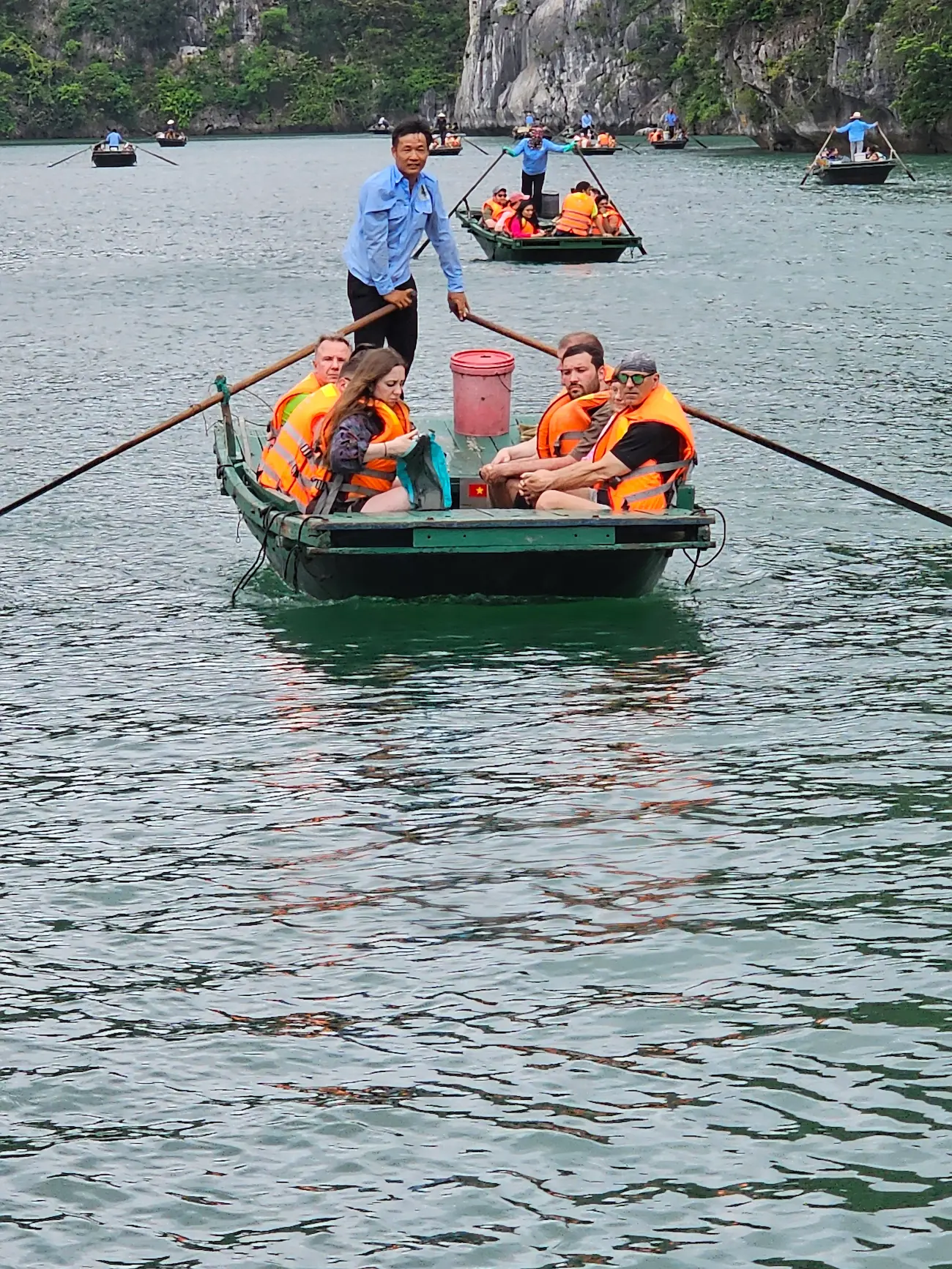 There's no room for forty in this boat
What breaks with
forty people
You ask on the phone and it turns out that "small" means twenty-five. Sometimes thirty-two, because that's what fits in the bus. We write the number before the phrase: 6 to 13 people. If we don't reach six, the trip doesn't run and 100% of the deposit is refunded.
For a while I thought that number was about comfort: fewer people, shorter lines. Then I started reading studies. And group size doesn't change the comfort of the trip: it changes what kind of experience is possible.
You wait
Counting heads before every transfer. Multiply thirty seconds by forty people and by the number of times it happens in a day: You're giving away hours of your journey to the asphalt.
Questions that are not asked
Raising your hand to ask something that only interests you feels like breaking everyone's rhythm.
Zero margin
If someone wants to stay ten more minutes in a temple, they can't. The group either moves as a unit or it doesn't move at all.
Anonymity
You can spend two whole weeks without anyone outside your own row knowing your name.
None of this is the operator's fault. It's pure mass physics: above a certain number, a group stops functioning as a group of people and starts being managed as cargo that needs to be moved.
 Mui Ne · thirteen fit in three jeeps. Forty need ten, and from then on you are not going anywhere together.
 Ayutthaya · descending, not posing
A conversation doesn't last
more than four
Researchers who observe spontaneous conversations —in the street, on a campus, in a bar— always find the same ceiling. Krems and her colleagues measured it in 2016: around four participants truly speaking and listening.
One of the proposed explanations has to do with how many minds you can hold at once. Beyond that it gets harder, and the group splits by itself into subgroups.
In a group of thirty, there's rarely just one conversation: there are several happening in parallel, and you're in one of them. Subgroups form on the first day and tend to stay that way. You end up having the farewell dinner with the same four people as the first breakfast.
In a group of eleven they form too, but there are many more chances for them to mix. It doesn't guarantee anything: there can be pairs that close off and people who don't click. What changes is how many times you cross paths with each person.
Krems et al. · 2016The larger the group,
each one contributes less
In 1913, agricultural engineer Max Ringelmann measured people pulling on a rope while searching for the best oxen configuration for plowing. A single person pulls at 100%; eight together, at around 49% each. The original work is known mainly through a later summary, so that number should be taken with a grain of salt.
For decades it was believed to be a lack of coordination. In 1974 Ingham, Levinger, Graves and Peckham separated the two: blindfolded participants pulling alone, convinced there were people behind them. The effort dropped just the same. Five years later, Latané, Williams and Harkins replicated it and gave it a name: social loafing.
The key is being seen
The effect is corrected when each person's contribution is identifiable. When you are seen, you pull your weight.
One caveat that works against me
Ingham found that the drop is not linear but curvilinear: it drops sharply from one to three people and then flattens out. This does not prove that forty is twice as bad as twenty.
What it does show
That when you stop being identifiable, you take part less. On a trip: it is harder for someone to suggest "what if we leave earlier tomorrow to see the sunrise?".
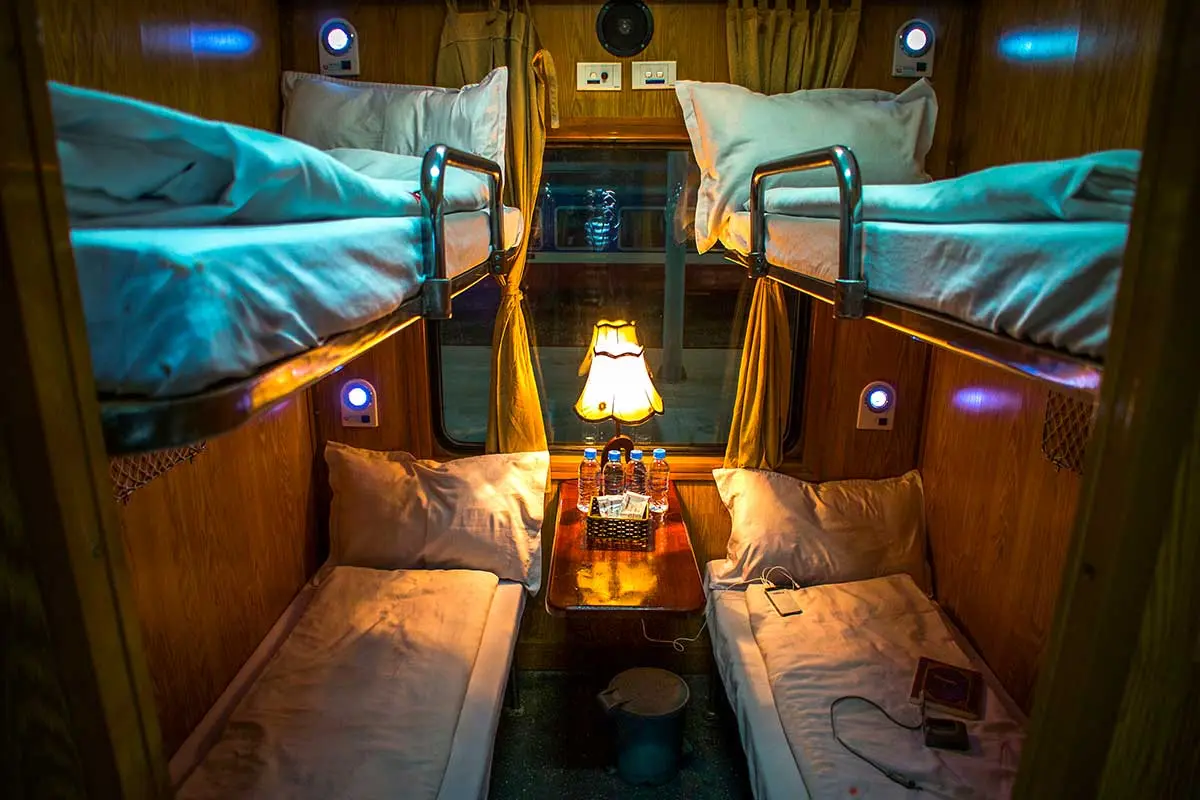 This photo isn't mine. My lens fogged up on the night train due to the humidity, and I couldn't get a decent one. Stock photo.
 Mui Ne · In a vehicle like this, you can tell who's missing
Nobody realizes that
you have fallen behind
In 1968, Darley and Latané staged a fake intercom conversation. Midway through the session, a recording simulated an epileptic seizure and called for help. When the participant believed they were the only one who could hear it, 85% helped. When they thought there were more people listening, only 31%.
Nobody was a bad person. Everyone thought the same: someone else must already be handling it. It's called diffusion of responsibility.
The logic has an interesting parallel with travel, although nobody has measured it in a tour group and the situation is far less serious. You feel unwell and say nothing. You have fallen behind in a market. In a group of forty there are forty people who could notice, and precisely for that reason it is easier for nobody to do it in time.
In a group of eleven, with someone from the agency inside it, if you are missing it shows before you say so. It isn't a service we sell: it is what happens when there are few of you.
Darley and Latané · 1968What you watch with someone next to you
grows bigger for you
The chocolate experiment
Boothby, Clark, and Bargh (Yale, 2014) seated people to taste chocolate next to another person. In one case, the two ate at the same time; in the other, the companion was present but looking at a sketchbook. In neither case did they speak to each other. Chocolate shared in silence was rated as tastier.
And with dark chocolate
They repeated the experiment with unpleasant chocolate. Shared, it was rated as worse. The conclusion is not that sharing improves things: it's that sharing amplifies. Good things get better, and bad things get worse.
What amplifies is not the company
It is the shared attention: that you are all looking at the same thing at the same time. At a viewpoint with thirty-five people, a third are in line, another third are looking at their phones and the rest are waiting for the guide to repeat the explanation. There are thirty-five people and there is no shared attention.
Why strangers end up becoming friends
Min, Liu and Kim (2018) found that sharing extraordinary experiences brings two strangers much closer than sharing something ordinary. They propose that it works because the experience absorbs attention and pulls it away from the awkwardness of getting to know someone.
The finishing touch
That effect doesn't appear among people who already know each other well. Once trust is established, there's no initial awkwardness to overcome. In other words: if you're coming with your usual group of friends, the destination is what matters. If you're coming without knowing anyone, who shares the experience with you matters just as much as the country. If that's your situation, there's another article that will probably be more helpful than this one: traveling alone in Asia.
Thirteen o forty
Su, Cheng and Huang, Journal of Travel Research, 2021: Travelers in small groups perceive more value and are more satisfied. It doesn't prove that forty is a bad trip or that eleven is the right number. That's enough for me.
- You all fit around one table
- You all fit in a boat
- Your proposal affects twelve people
- If you are missing, it shows
- The guide knows your name on the second day
- You can stay for another twenty minutes
- You have to book a function room
- You need a bus
- Your proposal affects thirty-nine
- It is assumed someone else has already noticed
- You are a row
- The schedule dictates
The study found something else, and this is the honest part: when the members already knew each other well, the effect of size fades. Size matters a lot if you're traveling without knowing anyone.
The small group
also has a cost
It wouldn't be fair to only tell the good half.
It is usually more expensive per person
Dividing a guide, driver, and vehicle among eight people costs more per person than among forty. It's simple math, not marketing. When you compare two quotes and one is significantly cheaper, one of the things you're saving on is the number of people traveling with you.
You cannot disappear
In a group of forty you can do the whole trip being invisible, and there are days when that is exactly what you want. With eleven that option does not exist. If one day you do not feel like talking, it shows.
If someone doesn't suit you, there's no crowd to dilute them in
In a group of forty you avoid that person and that is that. In a group of eleven you are going to see each other every day. Long time together tends to undo that kind of thing more than it makes it worse, and the WhatsApp group opens weeks in advance so nobody arrives at the airport knowing zero people.
There are fewer people among whom to find your people
With forty people there is a greater statistical chance of finding someone who fits you completely. But also far less chance of getting to discover it.
There are thirteen spots, not eighty.
If you decide late, there may be no place left on the departure you wanted. It is not an urgency tactic: it is what setting a cap and respecting it means.
And it may not run
If we do not reach six, the trip does not happen. In that case the whole deposit is refunded, the full €300, no conditions. But the possibility exists and I would rather you knew it before booking than after.
Probably yes, if
- you travel alone and want to meet people without having to travel entirely alone
- you prefer the guide to know who you are
- you care about being able to get in where a bus cannot
- you value the experience more than the lowest price
- you accept paying a bit more to go with fewer people
Probably not, if
- you are looking for the cheapest possible organized trip
- you want to go unnoticed and isolate yourself for several days
- you feel like improvising the itinerary as you go
- you travel with your own group of friends, where size matters less
- you are comfortable traveling with thirty or forty people
Why 6 and why 13
What the research says
The size of the group influences how many people participate, how much your absence is noticed, how what you see is shared, and how much satisfaction people report upon returning. All of that has been studied.
What it doesn't say
That thirteen is the right number. There is no study that proves that thirteen works and fourteen doesn't. That doesn't exist. Thirteen is our decision.
Six
It is the minimum at which a trip like this holds up. Below that, a dedicated local guide and your own vehicle stop making economic sense, and the dynamic becomes fragile: If two people leave on their own one afternoon, there are three left.
Thirteen
It is where we started to see that what we wanted was breaking. A table stops being a table and becomes a special reservation. A boat stops being a simple option. An activity for ten starts needing two shifts. And when it comes to dividing, there is no longer one group: there are two.
And that is why we write it
We did not choose it because it sounds good: it is the ceiling below which the trip is still the trip we wanted to make. Another agency with other routes may set theirs at eleven or sixteen and be just as right as we are. What does not seem serious to me is not saying the number.
This is where a review would go. And I am not going to put one.
2026 is our first year. The four trips listed on the website are all first editions, and the first group just returned. I could have included the typical quotes from "María P., Madrid" saying that this trip changed her life, and you probably wouldn't have noticed. Or maybe you would have, if you pasted the phrase into Google.
As soon as we have reviews from people who have traveled with us, they'll go here. Exactly as they write them, no embellishment. Also those who say that something wasn't right.
Meanwhile, what I can offer you is a no-obligation video call, the phone numbers of two people who will answer, and a registered agency with insolvency insurance in case anything goes wrong. Which is, ultimately, what a review is trying to demonstrate.
 One of us is inside the group. Not a figure on a website: the person who picks up the phone.
The three doubts the usual ones
"What if I don't fit in with the people in the group?"
I'm not going to promise you'll get along with all thirteen people, because I don't know and that would be a lie. What I can tell you is that not just anyone signs up for a trip like this: it's people who have chosen the same thing as you being able to choose something cheaper and more comfortable. And the WhatsApp group opens weeks in advance: you don't arrive at the airport to meet anyone. It is in the same family as the excuses that stop you from traveling.
"I like to do things my own way — won't I feel tied down?"
A small group isn't a school trip. There will be time together and time to get lost with your camera. But I'll be clear about what no changes: the itinerary is closed before departure, with entrance fees paid, domestic flights booked and accommodation contracted. What a small group provides is leeway within the day, not an itinerary that is rewritten on the fly.
"I'm going alone — will I be the only one?"
No. It's the most common thing in our groups, and it makes sense: traveling like this gives you the independence to decide without waiting for your partner's or friends' schedules to align, but without eating dinner alone any night if you don't feel like it.
What they taught me
hiking trails
I have been going out walking for years. And there is one thing that always repeats: when you meet up again with the people you walked with, nobody talks about the scenery. They talk about what happened along the way. About the laughs. About the dancing afterwards.
I don't think travel is about accumulating places. I think it's about accumulating memories, and memories appear when there's space for things to happen on their own.
The same applies when you're away from home. There's a huge difference between visiting a place and feeling like you've truly been there. When someone returns from a big trip and you ask them how it was, they list everything: the monuments, the sites, the places they walked on. And without even realizing it, they're giving you the key to the difference between a trip and a TRIP.
My impression, after many years of listening to these conversations, is that after a few weeks the names start to get mixed up and all that's left is the photo album. With a small group, I've seen something different: months later, the feeling is still there.
That's why we limit group sizes. On a two-week trip, no one should feel like just a number.
 ToniCo-founder · SunZen Travel
What you ask us most
How many people go on a small group trip?
At SunZen Travel, from 6 to 13 people. Thirteen spots per departure is the real cap, not a guideline. If the minimum of six is not reached, the trip does not run and 100% of the deposit is refunded.
What if I don't fit in with the people in the group?
We can't promise you'll get along with all thirteen people. What is true is that not just anyone signs up for a trip like this: the people who sign up have chosen the same thing as you, when they could have chosen something cheaper and more comfortable. Also, the WhatsApp group opens weeks before departure, so you don't arrive at the airport to meet anyone for the first time.
I like to do things my own way, won't I feel tied down?
A small group tour isn't a school trip. There's time to be together and time to explore independently. The itinerary is set before departure: tickets are paid for, domestic flights are booked, and accommodations are arranged. What a small group offers is flexibility within the day, not an itinerary that gets rewritten on the fly.
I'm going alone, will I be the only one?
No. It's the most common thing in our groups. Traveling like this gives you the independence to decide without waiting for your partner's or friends' schedules to align, but without having to eat dinner alone any night if you don't feel like it.
Is it more expensive to travel in a small group?
Yes, it usually is per person. The cost of a local guide, a driver and a vehicle is split among fewer travelers. When you compare two quotes and one is considerably cheaper, one of the things you are paying less for is the number of people you will be traveling with.
Why 13 people and not more?
No study proves that thirteen works and fourteen doesn't: it's an agency decision. Thirteen is the point at which a table ceases to be just a table and becomes a special reservation, a boat stops being a simple option, and an activity for ten starts requiring two shifts. As soon as the group has to be divided, there is no longer a group.
Departures of 2026
- Vietnam in a small group17 days · Nov 2026
- Sri Lanka in a small group15 days · Oct 2026
- Thailand in a small group15 days · last departure
- Bali in a small group14 days · New Year's Eve
One of the two people who go on the trips answers, not a call center. By phone too: 604 92 81 72.

23 things no one tells you
before booking
28 pages about everything that happens before before boarding the plane: the myth of the last-minute bargain, the six-month passport rule, the invisible fees and the 70% suitcase rule.
Continue reading in the Inner Atlas
Reflections and destination guides already published.
- Krems, J. A., Dunbar, R. I. M. et al., on the size limit of spontaneous conversations (~4 participants); later theoretical review in Evolution and Human Behavior (2018).
- Ringelmann, M. (1913), rope pulling experiments, Annales de l'Institut National Agronomique. The original data are known mainly through Moede's summary (1927).
- Ingham, A. G., Levinger, G., Graves, J. and Peckham, V. (1974). "The Ringelmann effect: Studies of group size and group performance". Journal of Experimental Social Psychology, 10(4), 371–384.
- Latané, B., Williams, K., and Harkins, S. (1979). "Many hands make light the work". Journal of Personality and Social Psychology, 37(6), 822–832.
- Darley, J. M. and Latané, B. (1968). "Bystander intervention in emergencies: Diffusion of responsibility". Journal of Personality and Social Psychology, 8(4), 377–383.
- Boothby, E. J., Clark, M. S. and Bargh, J. A. (2014). "Shared Experiences Are Amplified". Psychological Science, 25(12), 2209–2216.
- Min, K. E., Liu, P. J. and Kim, S. (2018). "Sharing Extraordinary Experiences Fosters Feelings of Closeness". Personality and Social Psychology Bulletin, 44(1), 107–121.
- Su, L., Cheng, J. and Huang, Y. (2021). "How Do Group Size and Group Familiarity Influence Tourist Satisfaction? The Mediating Role of Perceived Value". Journal of Travel Research, 60(8), 1821–1840.