Inner Atlas · Thailand Series · SunZen Travel
The thread that binds you
on the wrist and why you should never cut it
The thread on your wrist in Thailand looks like a souvenir. A Cambridge anthropologist and thirty-two souls say it isn't.
Anthropologist Stanley Tambiah publishes in Cambridge the first major academic theory on the sacred Thai thread.
Each one lives in a different part of the body. The thread exists so that none of them can escape.
Neither Thailand nor Sri Lanka has a law requiring it to be cut. The thread decides when it ends.
Inner Atlas · The Sacred Thread
One gesture, two theories, three countries
The academic version, the animist version, and how it's really lived in Thailand, Sri Lanka, and beyond. Four series.
The sacred thread
The thread theory: what Tambiah discovered
In 1970, Cambridge anthropologist Stanley Tambiah published the first major academic study on the Thai wrist thread. His conclusion: the sai sin is not symbolic. It is, literally, a cable.
The thread acts as a conductor of spiritual energy.
Tambiah compares the thread on the Thai wrist to a cable: it is not an abstract symbol of protection, but the physical medium through which something real travels within the Thai worldview.
From the Buddha statue to your own wrist
One end is tied to the main image of Buddha. The thread passes through the hands of the monks as they recite scriptures in Pali, and ends unwound in the hands of the devotees., in a single continuous circuit.
The thread also passes through a container of water
Before reaching the hands of those present, the thread passes through water which the chants transform into holy water — a second point on the circuit, not just an accessory for the ceremony.
Sometimes the thread encircles a temple, a house, or an entire village
Tambiah documented how the monks unroll the sai sin around an entire perimeter, creating what he describes as a continuous shield in the face of negative influences.
An anthropologist who lived for two years in a village in northeastern Thailand
Stanley Jeyaraja Tambiah (1929–2014) published Buddhism and the Spirit Cults in North-East Thailand at Cambridge University Press. It's not a passing theory: it's real fieldwork, and remains an essential reference in the anthropology of Southeast Asian Buddhism more than fifty years later.
The vibration of the chants physically travels along the thread. By tying a piece to your wrist, you connect directly to that protective network.
The sacred thread
The 32 essences: the oldest theory
Before Tambiah, and before Buddhism itself, a different and older idea about why the thread is tied on the wrist already existed in Southeast Asia. Anthropologists of animism call it the kwan theory.
You don't have just one soul. You have thirty-two.
In the animistic worldview prior to Buddhism, each person possesses 32 vital essences or kwan —guardian spirits that inhabit different parts of the body: the eyes, the hands, the heart, the head.
The kwan escapes easily
A scare, an illness, a long trip, a wedding: any abrupt change can cause one of your 32 kwan becomes disoriented or wanders away—leaving you, according to belief, vulnerable and incomplete.
Su Kwan literally means “to call the spirit”
The ceremony —also called Baci in Laos and northern Thailand— exists to summon those wandering spirits and convince them to return to the body.
That's why the thread is tied, not placed
The knot on the wrist is not decorative:
Two theories, one same gesture: it connects you and restores you
Uniting Tambiah with the anthropology of kwan, the thread does two things at once: it connects you outward, to the sacred energy of the temple and of whoever ties it on you —and inward, gathering up your own pieces so that you to become whole again.

The sacred thread
Thailand, in practice
From theory to the street: the real name of the thread, its colors, who can tie it, and why the same logic rises to the Muay Thai ring.
The real name of the thread: สายสิญจน์
The ceremony in which they tie it up is called Bai Sri Su Kwan. White symbolizes purity and is the most common color, although in the north orange, yellow or red threads can be seen.
If you are a woman, the monk will not touch your skin.
Buddhist monks do not have physical contact with women because of their vows: they will drop the thread onto your wrist or use a cloth. It's not coldness, it's respect to its own standard.
In the north and northeast, the ritual is experienced in a circle
Several people sit together, tying threads to one another while an older person recites blessings. If you have the opportunity to experience this with a local family, it is one of the most memorable experiences of the entire trip.
You'll see it in a tuk-tuk, an exam, a bus
On the wrist of a driver stuck in Bangkok traffic, on a student before an exam, wrapped around the steering wheel of a bus. In Thailand, the sacred takes to the streets.
The same logic extends to the Muay Thai ring
The fighter wears a pra jiad on the left biceps and a mongkol on their heads, blessed by their master. In ancient times, warriors tore a piece of their mother's clothing. to take a piece of home to the battle.
Not all white thread sold on the street is real
An authentic sai sin is received free of charge from a monk at a temple. There is also the sai yong, almost identical at first glance but reserved for funeral rituals —don't get it mixed up.
How to behave if they tie one on you
Wear it for a minimum of three days. There is no universal religious rule that prohibits cutting it, but letting it fall on its own, without forcing it, is a widespread custom and a sign of respect.
Thank with a wai —hands together at chest level— and, if you want to go further, a khop khun khrap (man) or khop khun kha (woman).
A real sai sin is free, delivered by a monk during a ceremony — not by a street vendor.
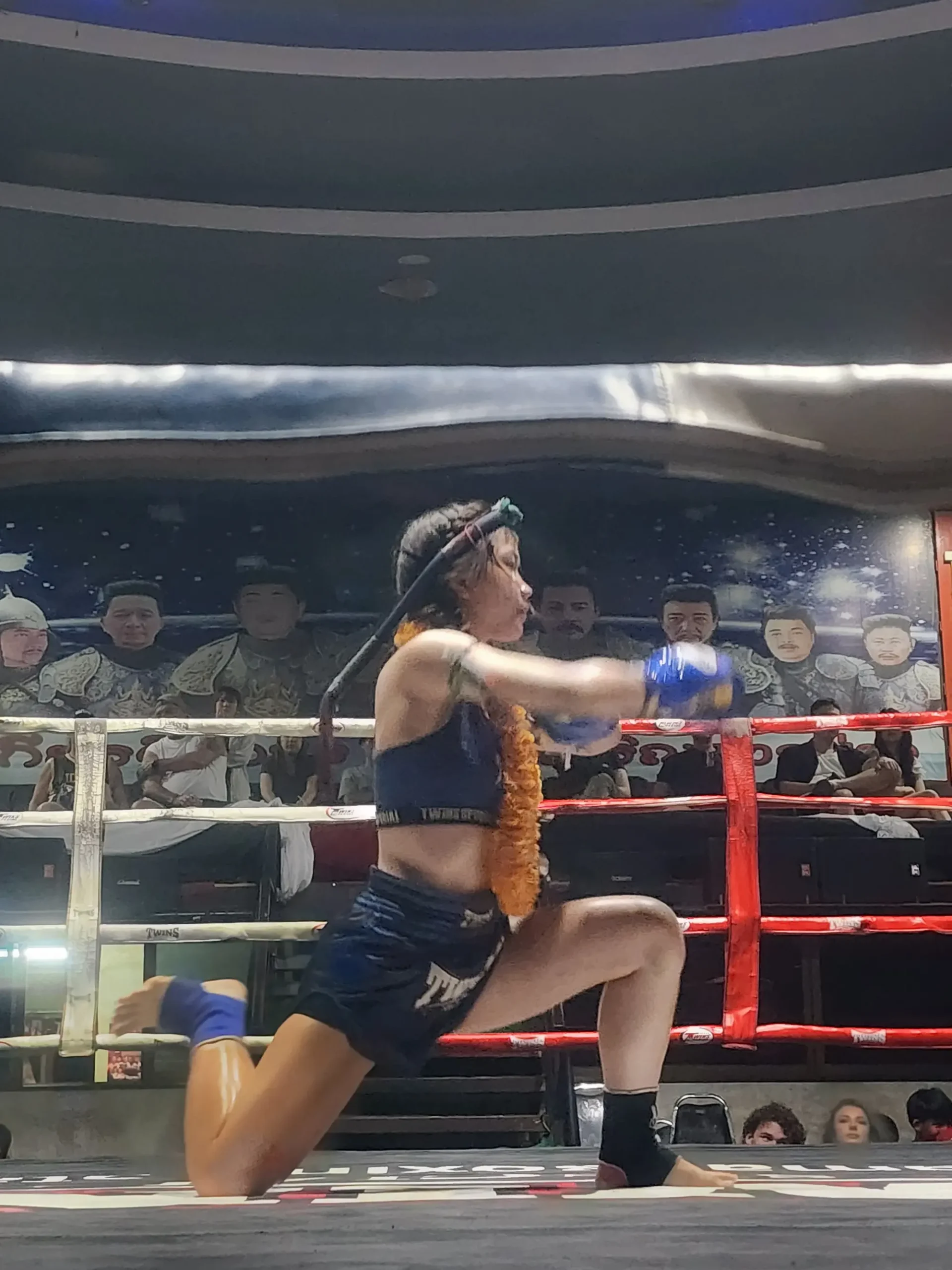
The same thread, with a different name, in another body.
Before a fight, the fighter wears a pra jiad in the left biceps—the one closest to the heart—and a mongkol on the head. In ancient times, warriors would tear off a piece of their mother's clothing to take a piece of home into battle.
The sacred thread
Sri Lanka, and the rest of the world
The same gesture, with a different name, in Sri Lanka. And further afield: in India, in Nepal, in Jewish Kabbalah. With no historical connection between them.
In Sri Lanka, the thread is sung before it is tied.
During a ceremony of pirith —the singing of sacred texts in Pali—, a thread is circulated which all those present hold while the singing lasts, before tying it on the wrist.
It is always tied on the hand that is considered clean.
Unlike in Thailand, in Sri Lanka the thread is always worn on the wrist right, because in this tradition it is the hand considered clean, as opposed to the left.
The same thread exists in India and Nepal, unrelated to Buddhist Asia.
The raksha sutra Hindu, tied by a priest, serves the same function of protection and blessing —a tradition with completely different roots to the Buddhists.
In Jewish Kabbalah there is an almost identical red thread
Tied to the left wrist, with no historical connection to Asia. Three religions, three continents, and the exact same protective gesture.
A white thread
Some countries try to impress you with monuments. Not Thailand. Thailand changes you with gestures so small they almost go unnoticed—one of them, a simple white thread tied to a wrist.
You'll see it in a monk. In an old woman. In a tuk-tuk driver. In a child. And perhaps, unexpectedly, one day someone will tie it to yours too.
At that moment, it's easy to think you've just received a bracelet. But no.
You just received a wish. A wordless "take care." A "may the road treat you kindly.".
In the West, we measure the value of things by their price. In Thailand, there are gestures whose value is impossible to buy—no one sells a blessing.
Perhaps that's why it's so moving. For a few seconds, a stranger ceases to be a stranger. And you cease to be a tourist.
It doesn't matter if you believe in karma or any religion. What matters is not faith. It's the intention. And in Thailand, intention matters much more than the object.
We live surrounded by things that don't last long. But there are memories that remain because they were never objects. They were emotions.
Because on that day you understand something that no temple can teach you on its own.
The sacred doesn't always reside in grand ceremonies. Sometimes it lives in the hands of a person who wishes good for another without expecting anything in return. Sometimes it's a cotton thread. And someone who decides to share a little of their good fortune with you.
Frequently Asked Questions
About the thread on your wrist in Thailand
What does the thread on your wrist in Thailand mean?
It's called sai sin And it's not a lucky charm. According to pre-Buddhist belief, each person has 32 vital essences or kwan that can escape after a fright, illness, or a major change. The thread is tied to secure them back to the body.
Why shouldn't the thread be cut?
There is no universal religious rule that prohibits it, but letting it fall on its own—without forcing it—is a widespread custom and a sign of respect for the person who tied it. It is customary to wear it for a minimum of three days.
Who can tie your thread?
The most common way to receive it is from a monk in a temple, during a ceremony. In northern and northeastern Thailand, there is also a communal version, the Baci, where several people tie threads to each other while an elder recites blessings.
Can you buy a sai sin?
An authentic sai is received free of charge from a monk during a ceremony; it is not purchased. What some street vendors sell as a "blessed" bracelet is not. There is also the sai yong, almost identical at first glance but reserved for funeral rituals.
Is there a similar thread in other countries?
Yes. In Sri Lanka it's called pirith nool and is tied on the right wrist after a Pali singing ceremony. In India and Nepal there is the raksha sutra Hindu, and in Jewish Kabbalah a red thread on the left wrist —with no historical connection between them.
Whenever someone asks me what gesture from Thailand still moves me after so many trips, it's this one. A thread, three knots, and someone wishing you the best without expecting anything in return.
Set a date.
We'll take care of the rest.
A maximum of thirteen people, one trip per year per destination, and one of us will be with you the entire trip.
The guide, free
Everything you need to know before setting a date.