Most people who go to Bali go for the same thing: temples, rice paddies for a photo, a beach at sunset. And they find it.
But beneath that lies an island that never ceases to amaze those who look a little closer. Volcanoes that are still shaping the landscape. A white bird that almost disappeared from the entire planet. Venomous snakes guarding a temple from a cave. And a reef that grows several times faster than normal because someone, twenty-five years ago, decided to run electricity through it.
This is what Bali has beneath the postcard.
Fire
I
Volcanoes that don't stop giving orders
01
The most important volcano is not the most visited.
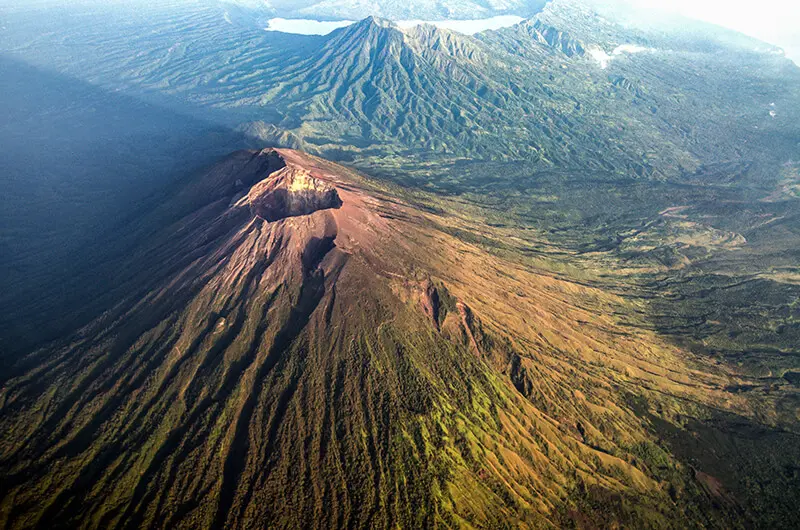
Mount Agung, at 3,031 meters, is the most sacred mountain on the island. Many people climb Mount Batur to watch the sunrise—but for the Balinese, the true spiritual center remains Mount Agung, considered the abode of the gods.
02
People sleep with their head facing the volcano
The orientation of many traditional houses is still determined by the location of the Agung (mountain). This is not merely a decorative custom. It has a profound spiritual meaning.
03
In 1963 the lava stopped a few meters from the most important temple
The eruption of Mount Agung wiped out entire villages. However, it stopped just short of reaching the main Besakih complex, built on the volcano's slopes more than a thousand years ago.
For many Balinese, that was no coincidence.
04
Volcanoes don't divide the Balinese: they nourish them
Volcanic ash is the reason Bali has some of the most fertile soil in Indonesia. Without the volcanoes, the terraced rice paddies that everyone photographs simply wouldn't exist.
05
The island is still growing
Eruptions and geological activity continue to reshape the landscape. Very slowly, each year, Bali is not exactly the same island it once was.
06
The irrigation of the rice fields is almost a thousand years old and is protected by UNESCO.
It's called Subak, And it distributes water among farmers through collective agreements between villages and temples—not according to who has more land or more money. It still works exactly the same way today.
Tegalalang. A thousand years of agreements between farmers, carved into a hillside.
Tide
II
The sea that changes color several times a day
07
Black, white, and golden beaches — on a small island
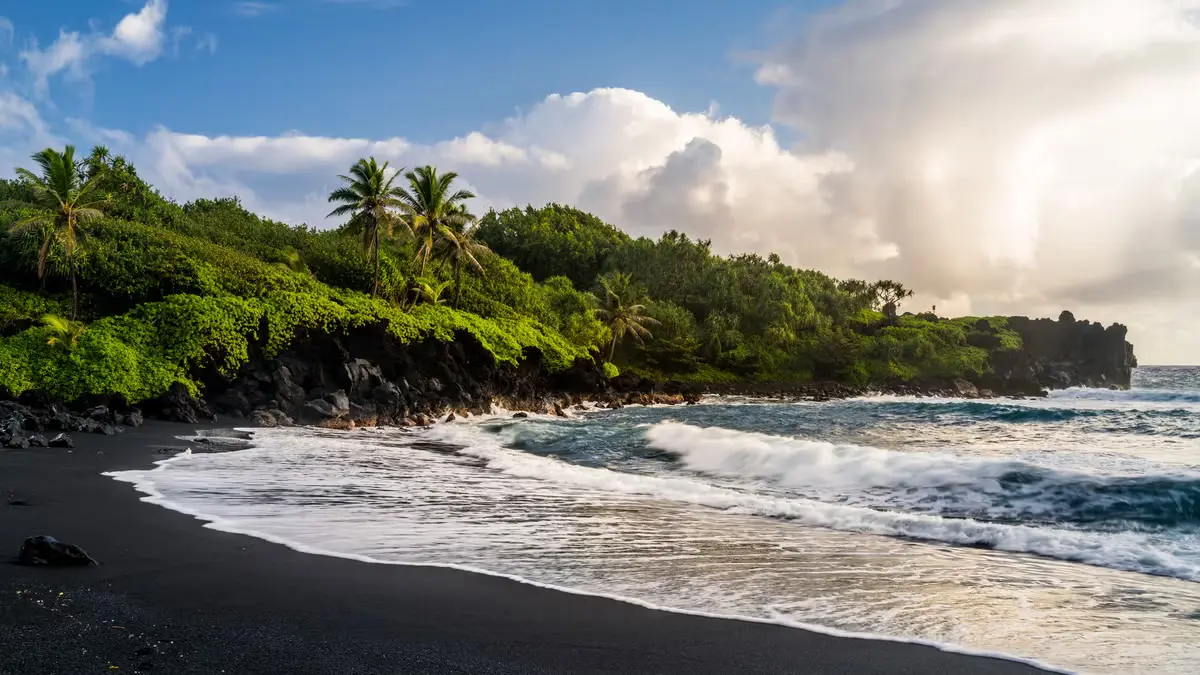
The black sand isn't pollution or dirt: it's ash from ancient volcanic eruptions. You can experience a completely different coastal landscape in less than two hours by road.
08
There is a temple that disappears with the high tide.
Tanah Lot appears to float on the sea when the tide rises. It's one of the most photographed sights in all of Indonesia—and can only be reached on foot at low tide.
09
Beneath that temple live venomous snakes considered sacred
They are black and white banded sea serpents, and they live in a cave at the foot of the rock. Balinese tradition says they were born from the sash of a wandering priest, who left them there to protect the temple from evil spirits.
It's not just a legend: they're there. The guardians of the place allow you to see them — and, with great care and always accompanied, even touch them.
10
A reef that grows faster because it receives electricity.
In Pemuteran, in the northwest of the island, a group of scientists and divers began in 2000 to submerge metal structures and pass low-voltage current through them. The coral that attaches to them grows several times faster than normal and withstands the water's heat better.
Today there are 115 structures scattered throughout the bay, covered in coral, and is one of Indonesia's largest reef restoration projects.
11
Some beaches disappear completely depending on the tide
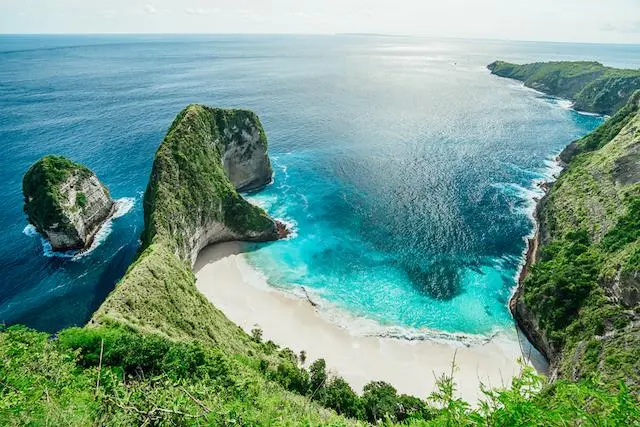
In certain parts of Nusa Penida you can walk where, a few hours earlier, there were several meters of water above you.
Black sandAsh from eruptions that occurred centuries ago.White sandThe same island, two hours further by road.
Below
Bali does not hide its nature. Simply put, almost no one looks up from the postcard.
Fauna
III
The animals that nobody expect to find here
12
There is a bird that lives only in Bali — and it almost disappeared from the planet
The Jalak Bali is almost entirely white, with black wingtips and blue skin around the eyes. It is the only bird endemic to the island.
Its wild population once fell below one hundred individuals, and at its worst, records show only a few remaining in the wild. Today, several breeding and release programs are attempting to reintroduce it to the forests of the island's west.
The fact
It is still listed in critically endangered by the IUCN Red List. It is probably one of the rarest birds in the world.
13
The monkeys of Ubud have learned to negotiate
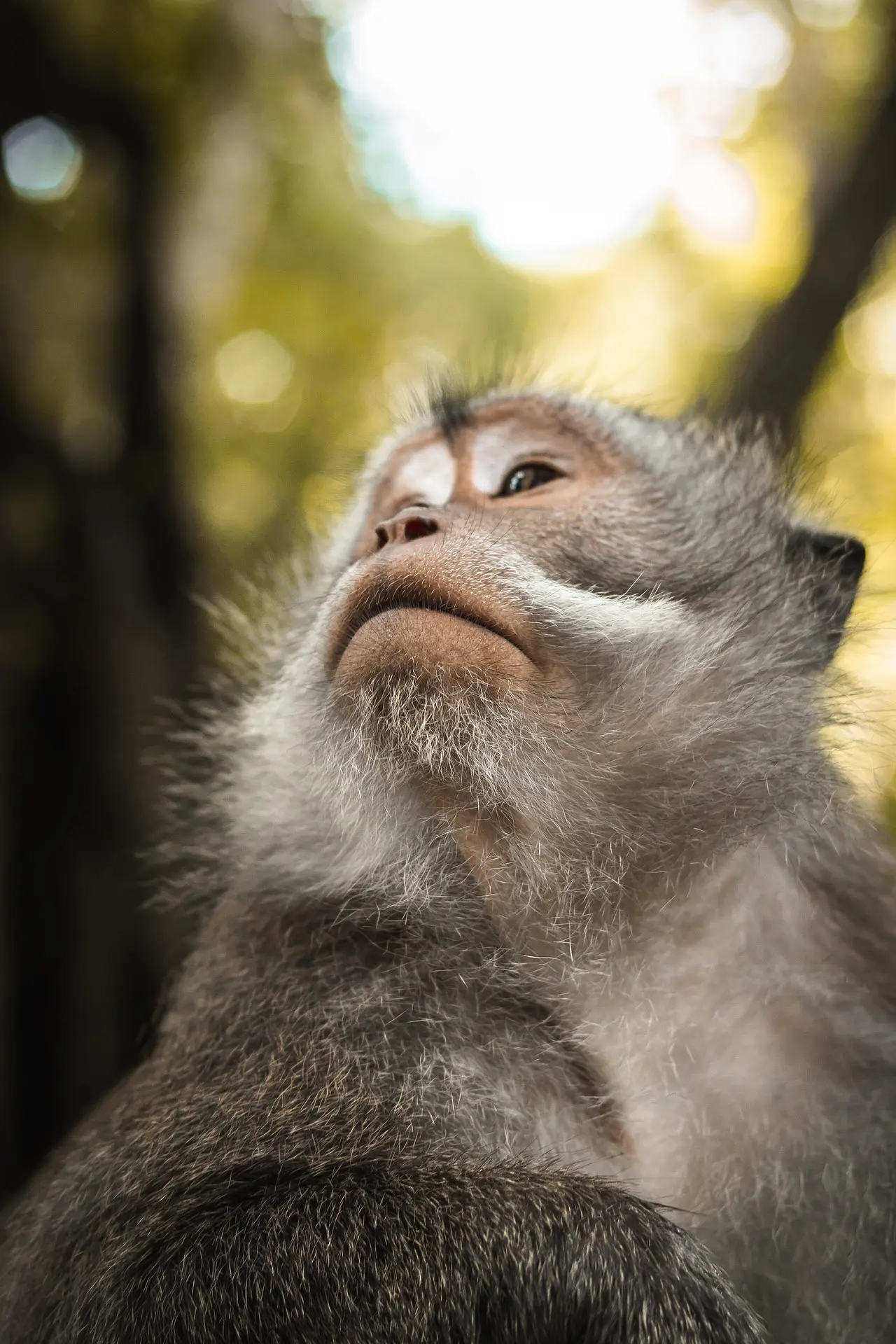
They steal glasses, mobile phones and bottles because they know perfectly well what will happen next: someone will offer them food in exchange for returning them.
And they don't steal just anything. Some studies have observed that they seem to prefer precisely the items that a tourist values most — that is, those with which they are most successful in negotiation.
14
Here appears the heaviest bony fish on the planet
The Mola mola, or ocean sunfish, can weigh over two tons. It can be seen off Nusa Penida at certain times of the year, when it migrates up from colder waters.
15
Giant manta rays fly underwater
Some specimens have a wingspan of over five meters. Seeing them fly overhead is one of those things you never forget.
16
There are turtles that return to the exact beach where they were born.
Decades later, and from the other side of the ocean.
17
Giant bats are the gardeners of the island
With their wings outstretched, some easily exceed one meter in length. And they're not just there for show: they feed on fruit. they disperse seeds, pollinate and regenerate the forest nightly.
Some species travel enormous distances in a single night. Much of the rainforest you see during the day was planted by them at night.
18
Fireflies still light up some rice paddies
They are becoming increasingly difficult to find — but they are still there, in the areas where the countryside still lacks artificial light.
Ubud
Hold on to your glasses before entering
The Ubud Monkey Forest is not a zoo or a staged attraction: it is a sanctuary with temples inside, where hundreds of long-tailed macaques live freely.
They arrived first. And they have spent generations studying how people who pass through there behave.
The macaques of Ubud. They know exactly what they're doing.
Seabed
IV
What there is underwater
19
Bali is located within the area with the most marine life on the planet.
Its waters form part of the Coral Triangle, The region is home to approximately 751% of all known coral species in the world—more than six hundred—and some 2,000 species of reef fish. In marine terms, it is the equivalent of the Amazon.
And in Bali, specifically
Scientific studies conducted in the Nusa Penida marine protected area have documented nearly 300 species of coral and 576 species of reef fish — in an area that can be covered in a single day's sailing.
20
Some dives pass through ancient lava fields
Bali's underwater landscape is as marked by volcanoes as its surface. You dive over black rock that once slammed down a hillside.
21
There is a sunken ship turned into a reef
The Liberty, in Tulamben, is one of the most famous shipwrecks in Southeast Asia. Today it is completely covered in coral and marine life—nature has fully reclaimed it.
Five meters wingspan passing overhead, without making a single noise.
Root
V
Trees that wear clothes
22
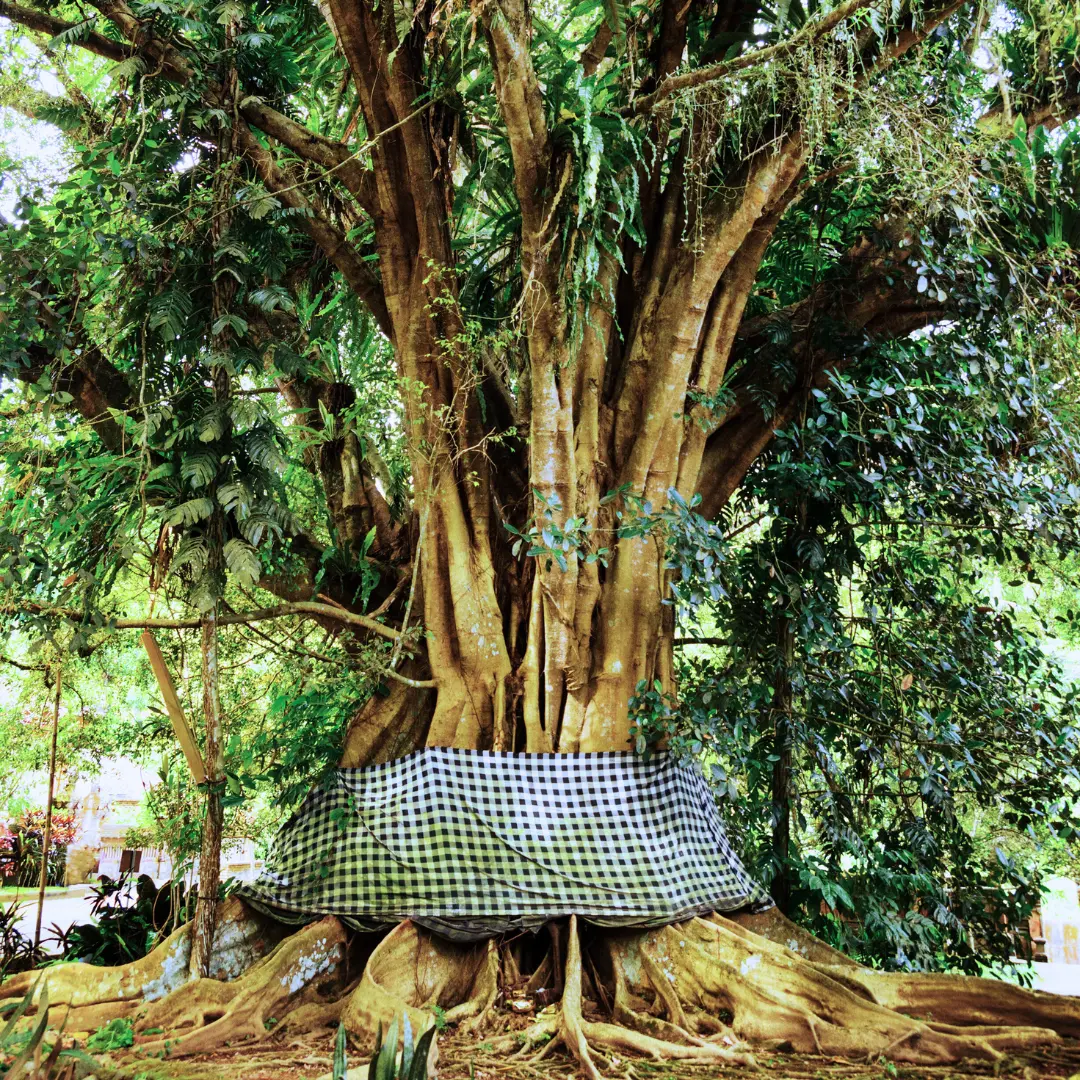
If you see a black and white cloth tied to a tree trunk, that tree is sacred.
It's not decoration or tourist signage. It's a way of indicating that something inhabits that tree that deserves respect.
23
Cutting down one of those trees may simply be unthinkable.
Even if it obstructs a road. Even if it complicates a construction project. Another solution is being sought.
24
Some banyan trees have been there for centuries.
Its aerial roots hang from the branches, take root in the ground, and grow into new trunks. Over time, a single tree eventually forms something resembling an entire forest beneath a single canopy.
25
And there is a tree that is said to absorb the smell of death.
It is called Taru Menyan and it grows in Trunyan, a village on the shore of the lake
It is one of the most surprising customs in all of Indonesia — and it's enough for a whole article.
Poleng
The fabric is not an ornament: It's a warning
The black and white checkered fabric you'll see tied to tree trunks, statues, and doors all over the island is called poleng.
It doesn't represent good versus evil. It represents that both forces exist simultaneously, and that neither functions without the other. When you see it in a tree, that tree has ceased to be just a tree.
A banyan tree dressed in poleng. From here on, permission is requested.
Nusa Penida
The island next door is another island
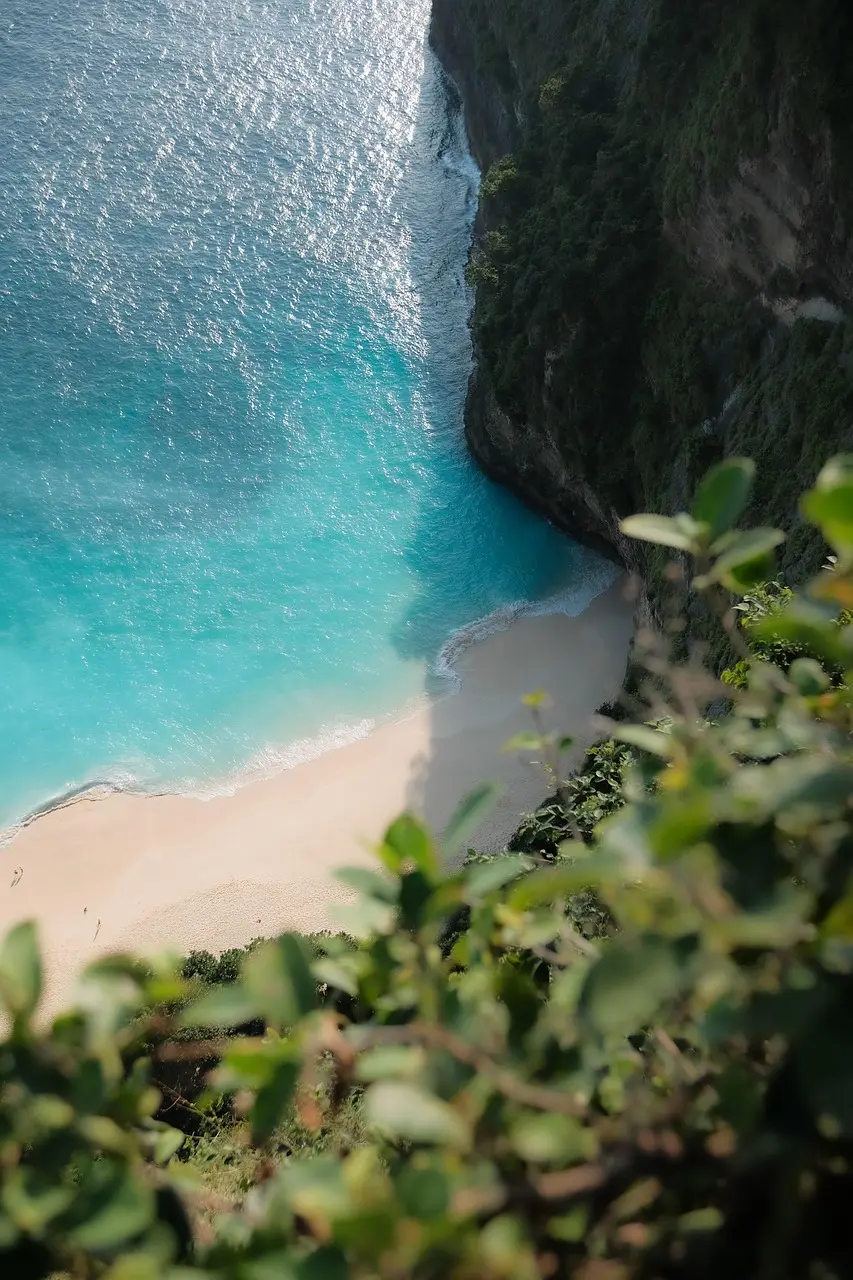
Half an hour by boat from Bali, Nusa Penida operates by its own rules: sheer cliffs, beaches that appear and disappear with the tide, and water where manta rays and sunfish can be seen.
Almost all tourism is concentrated in a small strip of southern Bali. Everything else remains pretty much the same.
Nusa Penida. Half an hour by boat and another world.
13
Small-group trips
Bali can also can be felt.
Groups of up to thirteen people. Everything is taken care of. You decide; we'll handle the rest.
When you start researching Bali, you discover something curious: the more you read, the less it seems like a destination and the more it feels like a different way of understanding life. Behind every volcano, every rice paddy, and every tree adorned with flowers lies an explanation that has been there for centuries.
This article stems from that curiosity. It is not intended to be a guide to must-see places, but rather an invitation to understand the island before setting foot on it. Because traveling begins long before you board a plane.