Inland Atlas · Interesting Facts About Thailand · Series 04
Thai Cuisine
that No one explains it to you.
Beyond Pad Thai. Thai cuisine has secrets, rituals, and interesting facts that you can only discover when you arrive knowing where to look.
Thai cuisine is hard to understand. It's being tested.
Thai cuisine is one of the most complex and surprising in Asia. Five flavors in perfect balance—sweet, salty, sour, bitter, and spicy—in every dish.
And beneath that complexity lies a series of curiosities and traditions that make eating in Thailand a a completely different experience.
Red Bull He was born in Thailand
The world's best-selling energy drink was originally called Krating Daeng — Red Bull in Thai. It was created in the 1970s by a Thai pharmacist as a drink for truck drivers and night shift workers. An Austrian businessman tried it, bought the formula, added carbonation, and brought it to the global market. Thailand continues to produce its own original version, which is non-carbonated, sweeter, and more concentrated.
Pad Thai was invented by the government
In the 1940s, the Thai government launched a campaign to reduce rice consumption and encourage people to eat noodles, which were more affordable. They created a new dish—stir-fried noodles with egg, bean sprouts, and peanuts—and promoted it as the national dish. Pad Thai has a history dating back just 80 years and it is a government initiative, not an ancient tradition.
Chili peppers are not native to Thailand — arrived 500 years ago
Chili peppers were brought to Thailand by Portuguese traders in the 16th century. Before that, Thai cuisine relied on ginger and pepper for heat. In less than two centuries, the chili pepper became the defining ingredient of Thai cuisine. One of the fastest and most widespread cultural adoptions in the history of world cuisine.
Discovering Thai Cuisine dish by dish, market by market.
View the trip to Thailand →The Best Cuisine in Thailand is on the street
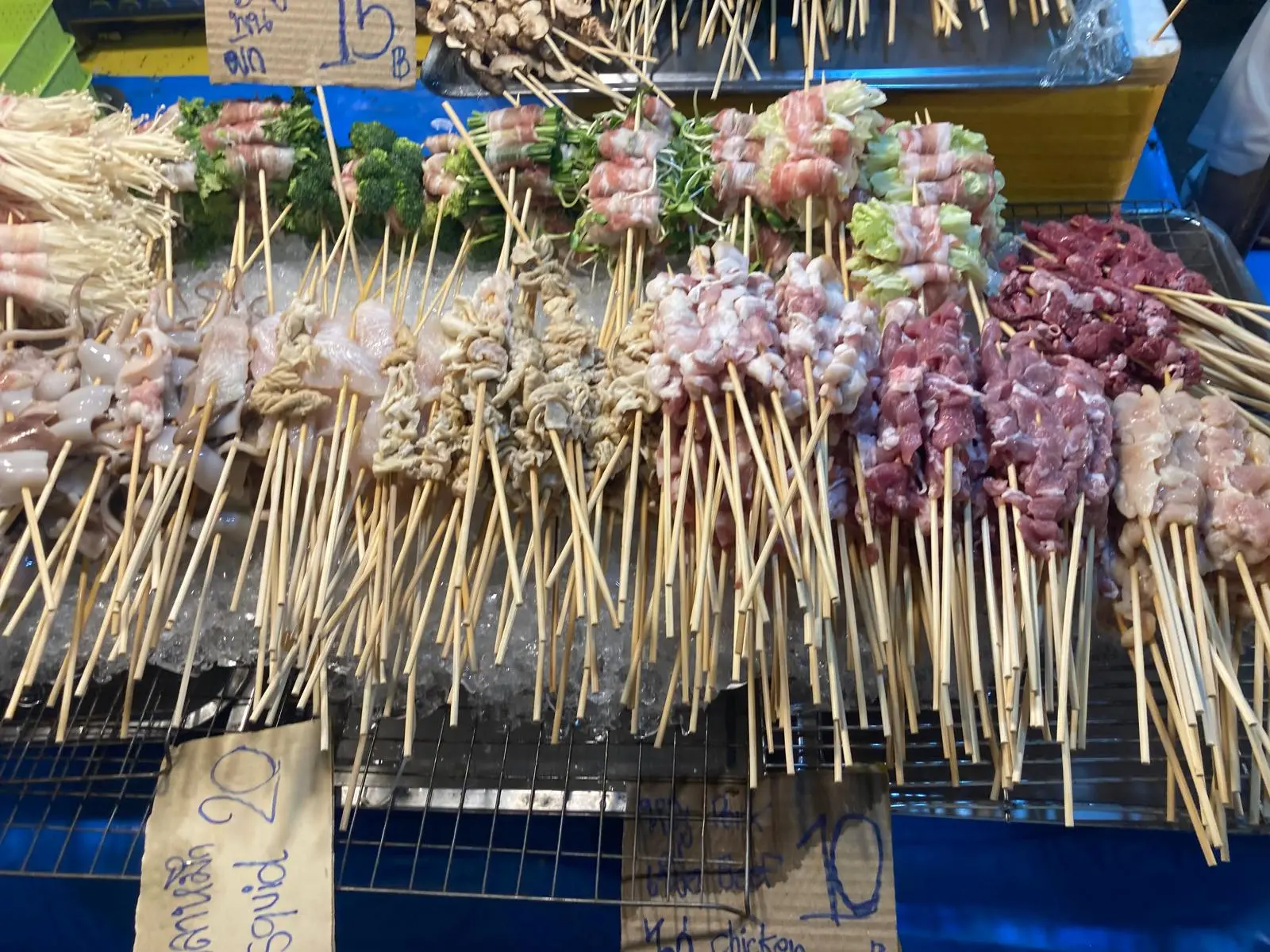
In Thailand, the best chefs don't work in Michelin-starred restaurants. They work at street stalls with a wok, a pot, and decades of experience. Bangkok has more street food vendors per square kilometer than any other city in the world. The Michelin Guide began featuring Thai street food stalls in 2017 — the first was Jay Fai, a woman wearing diving goggles who has been cooking with a wok over a charcoal fire since the 1970s.
Floating Markets They start before dawn
The most authentic Thai floating markets open at 4 or 5 in the morning. Vendors arrive by boat, loaded with fresh produce and prepared food. The one in Amphawa, 90 minutes from Bangkok, is the most authentic and the locals' favorite. The one at Damnoen Saduak is the most photographed, but it's also the most overrun with tourists.
Fried insects are an everyday snack
Crickets, beetles, silkworms, scorpions, and fried cockroaches are sold at street stalls throughout Thailand. They are not a tourist attraction — They are a common, inexpensive snack that is high in protein and has been eaten by Thais for centuries. Fried crickets with salt and lime are the most popular. They taste like nuts.
In Thailand, cuisine isn't just about what you eat. It's where, how, and with whom you eat it.
The Fork in Thailand not for eating
In Thai cuisine, the fork is used to push food onto the spoon—never to bring it directly to the mouth. Eating with a fork in your mouth is considered bad manners, similar to what for us would be eating with a knife. The spoon is the main utensil. Chopsticks are used only for Chinese food.
Durian is prohibited in hotels and transportation
Durian is Asia's most famous and controversial fruit. Its smell is so strong and lingering that It is prohibited in most hotels, airports, the subway, and public transportation in Thailand. There are specific «no durian» signs next to the «no smoking» signs. For Thais who love it, it’s the fruit of the gods. For those who don’t, it’s unbearable.
Ordering «not spicy» in Thailand does not guarantee anything
The levels of spiciness in Thai cuisine are very different from those in Western cuisine. What a Thai person considers «mildly spicy» may be unbearable for a European. The Thai spice scale begins where ours ends. Learn how to say mai phet (mild) and hopes that, even so, it might come with a little chili.
Thais eat five times a day
Thai cuisine does not follow the concept of three set meals. Thais eat when they are hungry—usually five or more times a day in small portions. Food is available at any time at street stalls that never completely close. There's no set time for lunch or dinner: there's always food, and you're always hungry.
The kaffir lime leaf It's in almost everything
The kaffir lime leaf is one of the most distinctive ingredients in Thai cuisine. Its intense citrus aroma is found in curries, soups, salads, and marinades. In Thailand, it is used in cooking, traditional medicine, and spiritual rituals. It is impossible to understand Thai cuisine without this leaf, which does not exist in Western cuisine.
Thai Iced Tea It's orange because of the food coloring
Cha yen—Thai iced tea with condensed milk—gets its distinctive orange color from the food coloring added to the black tea. It's not the tea's natural color: it's an aesthetic tradition that began in the 1940s and which the Thai people have kept because they love the color just as much as the flavor. Sweet, creamy, and addictive.
«Have you eaten rice today?» It's like asking, «Are you okay?»
In Thai, the word kin khao It literally means «to eat rice»—but it’s used to mean «to eat» in general. Rice is so central to Thai cuisine that The usual polite question among friends is, «Have you had rice today?» — which is equivalent to our «How are you?» If someone hasn’t eaten rice, something’s wrong.
Discover Thailand
really it is not
arrive with a guide.
Thai cuisine is just the beginning. It’s about arriving with the right people. In the moments that matter. With time to understand what can’t be explained, It feels that way.
Co-founder of SunZen Travel. Traveler. The best moments of my trips weren't on the itinerary.